The test-drive checklist: what to test and what a test drive can't tell you
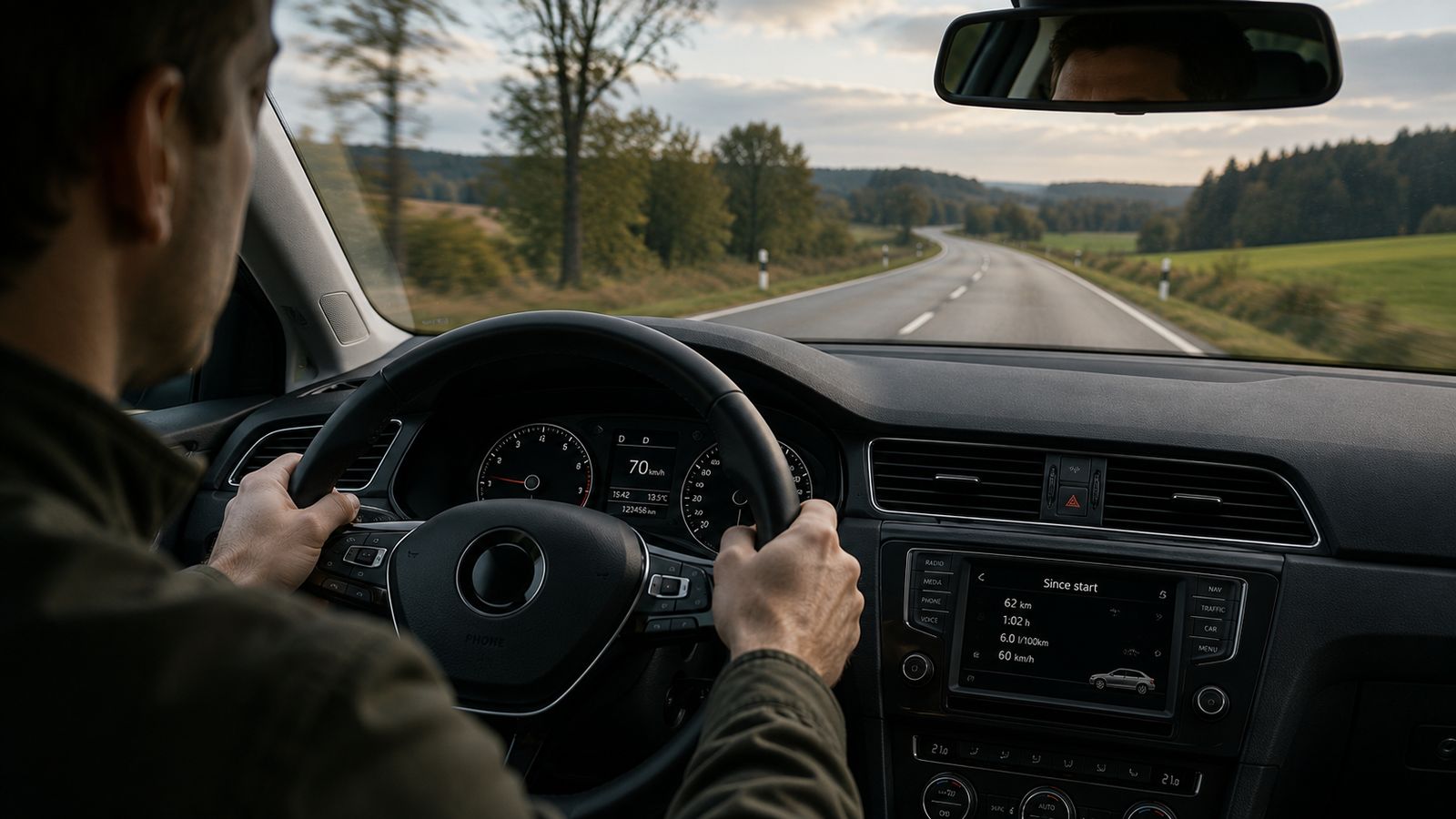
A thorough test drive covers seven phases (cold start, steering, brakes, transmission, noise at speed, electronics, and suspension) and takes at least 20-30 minutes on varied roads, not five minutes around the block. A warning light that stays on after startup, or milky exhaust smoke that lingers, are both reasons to stop and ask questions rather than continue. What a test drive fundamentally cannot tell you is the car's accident and ownership history: for that, you need documentation, not a drive.
A thorough test drive works through seven phases in order: cold start, steering, brakes, transmission, noise at speed, electronics, and suspension, and it should last at least 20-30 minutes on a mix of road types, not five minutes around the block on a route the seller chose. A dashboard warning light still lit after the engine's been running, or exhaust smoke that lingers rather than clearing quickly, are both reasons to stop and ask direct questions before continuing. Just as important: a test drive can tell you a lot about how a car feels right now, but almost nothing about its accident, ownership, or total-loss history: that requires documentation, not driving.
Why the order matters
Most of what a test drive is supposed to catch only shows up under specific conditions: a cold engine, a hard brake, a bumpy road, full steering lock. Driving the same easy 10-minute loop the seller always uses, on an engine that's already warmed up before you arrive, hides exactly the problems a test drive exists to find. Insisting on your own route, and starting from a cold engine, is the single biggest difference between a test drive that actually tests something and one that's just a pleasant ride.
1. Before you start the engine
Do a 60-second check before you even turn the key: seat and mirror position, that the fuel or charge level is enough for a real drive (not just around the block), and that the engine is genuinely cold: feel the bonnet or ask when it was last run. A seller who's "warmed it up for you" has removed your best chance to catch a rough cold start.
It's also worth deciding your route before you get in. A loop that includes a stretch of open road where you can reach normal cruising speed, a few tight turns at low speed, and at least one road surface rougher than smooth tarmac will tell you far more than a route chosen entirely by the seller. If the seller pushes back on your route or on driving the car cold, treat that as information in itself.
2. Cold start and warm-up
Start the engine and listen before you touch anything else. A brief rattle that clears within a second or two as oil pressure builds can be normal on some older engines, but persistent knocking, tapping, or rattling is not. Watch the dashboard: every warning light should illuminate briefly at startup and then go out; anything still lit after the engine has settled (engine management, oil pressure, battery) needs an explanation before you drive any further (Carsa, "What to Look for During a Test Drive"). Also check the exhaust: light white vapour on a cold start is normal condensation, but thick smoke that lingers (white, blue, or black) points to a specific underlying problem (coolant, oil, or fuel mixture, respectively) rather than a passing cold-morning effect (NAPA Know How).
3. Steering and brakes
| Test | What to do | What you're checking for |
|---|---|---|
| Straight-line tracking | Drive on a flat, straight road and briefly release light pressure on the wheel | The car should hold its line, not pull to one side |
| Steering feel | Turn the wheel through its range, including full lock at low speed | No excessive play, vibration, or grinding noise |
| Braking | Brake firmly (safely) from moderate speed | Even, straight deceleration; pulling to one side or vibration through the pedal are both flags |
| Handbrake | Apply on a slight incline | Should hold the car without slipping |
4. Transmission and clutch
On a manual, check the clutch bite point isn't unusually high or low, and that gear changes are smooth without grinding or hesitation. On an automatic, shifts should be smooth and appropriately timed: a hard clunk into gear, hesitation before engaging, or slipping (engine revs rising without a matching increase in speed) are all worth flagging to a mechanic before you go further.
5. Noise and behaviour at speed
This is where a short lap around the car park fails you completely. Most noise-related problems only appear at speed or under load. Drive on a road that lets you reach normal cruising speed, and listen for:
- Clunks or knocks over bumps (suspension components)
- Whining or humming that changes with speed, not engine RPM (wheel bearings, differential)
- Vibration through the steering wheel or seat at particular speeds (wheel balance or alignment)
- Any new noise when accelerating, decelerating, or turning that wasn't present driving straight at a steady speed
6. Electronics and comfort systems
With the car stationary or at a stop, work through everything electrical: every window, both mirrors, central locking, the infotainment system, and any driver assistance features the car is equipped with. Run the air conditioning on maximum cool for a few minutes and confirm it actually gets cold, and check the heating responds when you adjust the temperature control. These are easy to skip at the end of a drive when you're mentally already deciding: worth doing deliberately rather than as an afterthought.
7. Suspension and ride comfort
Find a road with some texture (potholes, expansion joints, uneven surface) rather than judging ride quality on smooth tarmac alone. The car should absorb bumps without excessive bouncing afterward (a sign of worn shock absorbers) and should feel controlled and settled, not floaty, through a series of dips.
8. What a test drive fundamentally cannot tell you
Everything above tells you how the car behaves today, in the hands of someone who knows exactly what to listen and feel for, over 20-30 minutes. It tells you nothing about:
- Whether the car was ever declared a total loss by an insurer and repaired for resale: a car can drive perfectly normally after being written off, since "total loss" is an economic classification (repair cost versus market value), not necessarily a statement about how the car currently performs (Wikipedia, "Total loss")
- Whether the odometer reading is genuine
- How many previous owners the car has had, or whether it was previously used as a taxi, rental, or lease vehicle
- Whether there's an open safety recall that hasn't been actioned
- Structural repairs that were done well enough to drive normally but weren't disclosed
A test drive and a documentation-based history check are answering two different questions ("does this car work" and "what happened to this car") and you need both before you commit. Treating a good test drive as proof the car has a clean history is one of the most common mistakes buyers make, precisely because a well-driving car feels trustworthy in a way that has nothing to do with what's actually on record.
A Plateop report covers the second question, though not by checking the VIN against a register itself: it works from the listing, the asking price and verified model knowledge, turning that into specific checks so you're not relying on how the car feels in a 20-minute drive to judge things a drive was never going to reveal. It's upfront about what it can't confirm, and where your market provides official history data, the report uses it and cites the source. Check any car before you buy at plateop.com.